


the
other
tradition

Hierarchy of Human needs in the City with no Labour
Hierarchy of Human needs in the City with no Labour
City with no Labour
In every European language 2 words, of anologous meaning exist, “work” and “labour”. “Labour” used as a noun is more related to a process with no end product, while “work” on the other hand, utilised both as a verb and a noun implies a finished object. Labour in French (‘travailler)’ originates from a word connotated with torture. “To labour”, in other words, means to be enslaved by necessity. Hannah Arendt discerns these two as “The labour of our body and the work of our hands, heart and intellect”. For her the fundamental condition of human existence can be divided into a hierarchy of human activities: LABOUR, WORK and ACTION. LABOUR relates to the reproductive activities sustaining biological life or analogous activities crucial to survival like food production and shelter. She describes WORK as the production of physical objects that transform human world into an artificial realm (designing for instance). ACTION signifies the activities ocurring between humans (such as politics, relations etc) being the only thing that can complete human existence.
In the current digital era, as members of the “society of labourers” we are witnessing the abolition of standard scheduling of everyday activities and 9-5 jobs, encouraged by the multi-tasking options provided by mobile devices and flexibilisation of jobs. We can work anywhere at any time. The bluriness of boundary between work and life creates a new condition of living where people live to work not work to live.
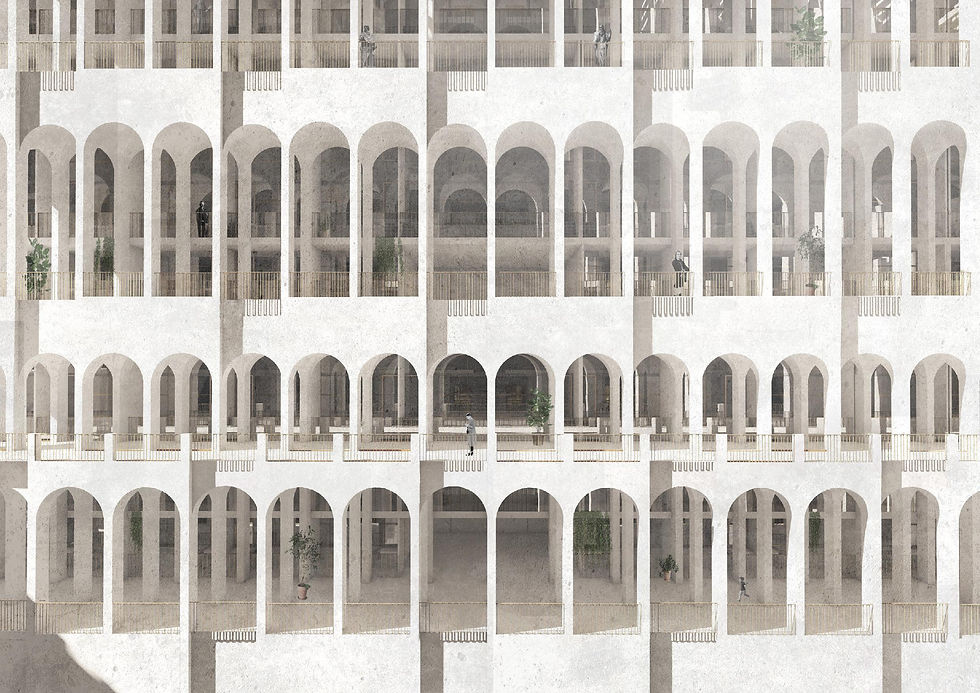
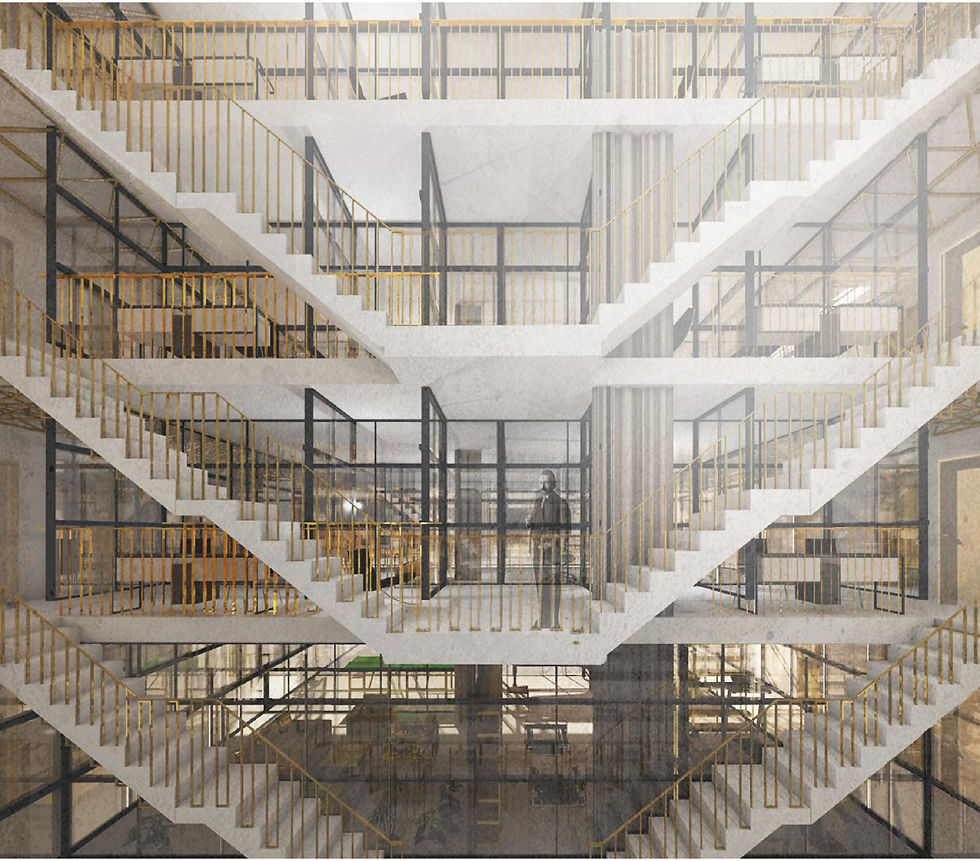
What if therefore, with the ongoing automation of the jobs, we were able to mechanise all the activities assumed as labour? How would a City with no Labour look like and function? The project speculates on the unimaginable post-labour society, where city centres will no longer be designed strictly around work and consumption. Commodities (typical products of labour), will not be merchandised on the high streets, deconstructing therefore the contemporary centres of labour.
With the eradication of labour from people’s lives, by giving the responibility of labour production to machines generating capital, what would be the new currency of living? What is it that makes us human? The project speculates the rise of action manifesting itself in civic boostism of political, social values or beliefs and the rise of the soft skill. This means exploitation of products of human intellect, which cannot be replaced by robots such as creative talent, emotional intelligence, critical thinking, communication skills, leadership abilities etc.
From a macro scale perspective to micro details analysis the project questions the worldwide social, cultural and political context (effects of automation of labour phenomena) having its historical context established (post-knowledge era, urbanisation and technological advancement). It bases itself in the strong neo-liberalist context of Chile, a nation which is often refered to as a modern day social and political experiment in terms of its’ geographical scales of capitalism shaped by organised labour.
The country experienced the ‘Chilean Miracle’ when its’ entire economic system in 1980s was converted from socialist to capitalist one following the military coup d’etat orchestrated by Augusto Pinochet. New free-market system established by the ‘Chicago boys’ has made the country the most rapidly economically developing one and with highest GDP per capita in Latin America. The policies, however, widened the inequality between classes and made the rich richer and the poor poorer. Currently, almost half of Chile’s population lives in the capital city of Santiago, since this is where the money and most of the work/labour is. The project focuses on a linear neighbourhood along one of the main arteries in Santiago,stretching from high end financial district of Sanhattan to city slums, and tries to envision how would this contemporary centre of labour look and function like if there was no more labour.